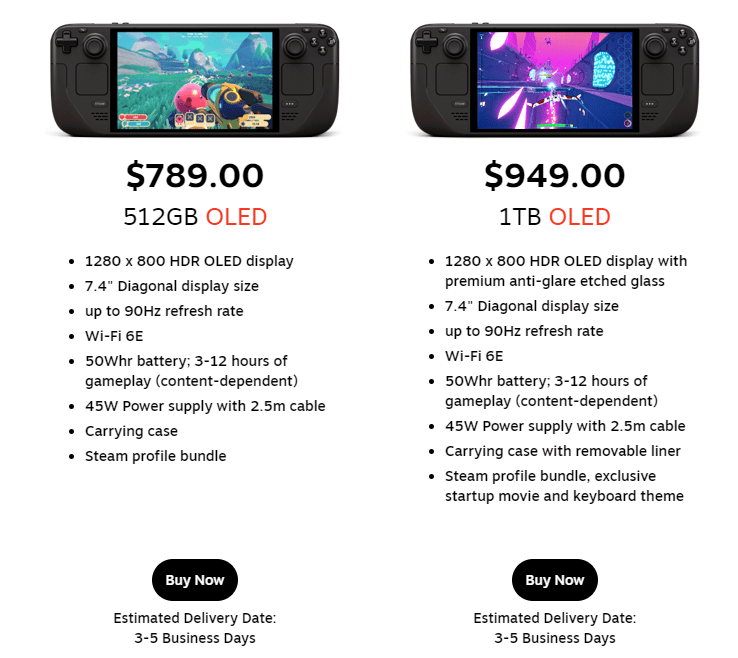
So the Steam Deck was out of stock for a while, and honestly it got kind of ridiculous because this is such an amazing handheld console. The good news is it’s back in stock now, but the pricing has shifted a bit over time. It’s still expensive compared to a few years ago. You’re looking at roughly around $399–$549 for the LCD base models depending on storage, and the OLED models now typically sit around $549–$649, with special editions or higher storage versions going even higher in some cases. So yeah, it’s not cheap, but at least you can actually buy it again.
It being out of stock for so long ties into a bigger issue too, which is the cost of PC hardware in general. A lot of people point to RAM shortages and rising component prices. DDR5 in particular is still way more expensive compared to DDR4. You can still sometimes find DDR4 RAM on places like Facebook Marketplace or eBay for cheaper, but DDR5 pricing has been pretty rough overall. That kind of thing also affects devices like the Steam Deck because it’s basically a portable PC, so supply chain issues and component pricing matter a lot.
What makes it even more interesting is that just a few years ago, you could build a decent budget gaming PC for like $500 to $600 that actually ran really well. Now that same price range feels tighter depending on parts. So when you look at the Steam Deck, even with its price going up slightly, it still feels like one of the best value portable gaming PCs you can get if you can get your hands on it.
If you do manage to get a Steam Deck, it’s honestly an incredible portable gaming machine. SteamOS boots up and immediately shows your Steam library, but you do need to log into your Steam account first. From there, it actually categorizes games based on how well they run on the device. Some games are marked as fully supported and run really well, others are “playable” but might need tweaks like control changes or UI adjustments, and some are marked as unsupported or unknown.
But one thing people don’t always realize is that those labels aren’t perfect. If Valve says a game is unplayable, it doesn’t always mean it truly won’t work. There are cases where games still run fine even if they aren’t officially supported yet. For example, some games that show limited support can still launch and run pretty well depending on settings and controller compatibility. You really just have to test some of them yourself.
That said, there are definitely exceptions. Some modern games, especially extremely high-end titles, just won’t run well or at all. And multiplayer games with strong anti-cheat systems are a big issue too. A lot of those simply don’t work properly on Steam Deck, so that’s something to keep in mind.
On the other hand, where the Steam Deck really shines is older titles and general PC gaming libraries. Games like Fallout 4, Rainbow Six Siege-style games (when supported), and tons of older PC titles run really well. There’s a massive library of games people still play today that work perfectly fine on it.
And then there’s emulation, which is honestly one of the biggest strengths of the device. You can turn the Steam Deck into basically a portable retro console. Nintendo 64 emulation works great, GameCube runs really well, PS2 works smoothly in a lot of cases, and there are tons of retro systems it handles without issues. You can even play Mario games through emulation without problems depending on setup. Newer systems like Switch emulation are more hit or miss though, and that’s not even just a Steam Deck thing—that’s an emulator development issue in general across PCs.
Another big plus is that the Steam Deck is actually upgradeable in certain ways. You can swap out the SSD to increase storage, and you can use docking stations to connect it to a monitor, TV, or even a full keyboard and mouse setup. So it can go from handheld to a semi-desktop setup pretty easily.
Performance-wise, the OLED Steam Deck is often compared to something around a PS4-level experience in handheld form, which is pretty impressive for its size. It’s still not on the level of a PS5 or high-end gaming PC though. Those systems are clearly more powerful, especially for demanding modern games. Because of that, something like GTA 6 is very likely not going to run well on Steam Deck, if at all, once it releases.
One workaround though is cloud gaming and streaming. Services like PS Plus Premium let you stream a large library of games directly to devices like the Steam Deck. You don’t need the game running locally since it’s handled on remote servers—just a stable internet connection. A lot of people overlook this, but it can massively expand your game library.
You can also use services like Xbox Game Pass cloud streaming in a similar way. That means in theory, combining Steam, cloud gaming services, and emulation gives you access to an absolutely massive library of games, way more than most people would expect from a handheld.
The main trade-off is always performance versus portability. A gaming PC will always be more powerful because it has more power and cooling available. The Steam Deck is smaller, more efficient, and portable, but it’s not going to match desktop performance. The LCD model is also limited to a 60Hz display, meaning 60 FPS cap in most cases, while the OLED models can go up to around 90Hz, which feels noticeably smoother.
And the OLED screen itself is a big upgrade. It looks way better than the LCD version in terms of color, contrast, and overall visual quality. If you’re buying one now, the OLED version is definitely the better pick.
Overall, if you can get a Steam Deck now that it’s back in stock, it’s still one of the best handheld gaming devices out there. It’s not perfect, but it’s extremely versatile. You can play it in bed, take it on vacation, dock it to a TV, or basically use it anywhere. For a portable gaming system, it’s hard to beat.
As for longevity, most estimates suggest around 5 years of solid use, but realistically it can last 5–10 years if you maintain it. The battery will eventually degrade, but it’s replaceable, and other components can be serviced or upgraded as needed.
Compared to devices like the ASUS ROG Ally or similar handheld PCs, the Steam Deck is often still considered the more balanced option. Those devices can be more powerful in some cases, but they usually cost more and run Windows, which can make the experience less optimized compared to SteamOS.
So yeah, overall the Steam Deck is still absolutely worth it if you can get one.
Link to video: https://youtu.be/S2r0OxqZEnA
 Niche Tech Space
Leave a comment